The National Drug Law Enforcement Agency has arrested a convicted cocaine trafficker who allegedly disguised himself as an herbal tea businessman and intercepted a 20,000-litre fuel tanker fitted with a concealed compartment containing over two tonnes of cannabis.
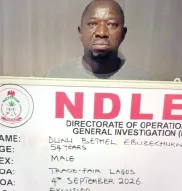
A statement on Sunday by the agency’s spokesman, Femi Babafemi, said the suspect, identified as 34-year-old Dunu Ebubechukwu, was arrested in a sting operation at Article Market, opposite Trade Fair Market, Ojo, Lagos, on Friday, September 4, 2026.
According to the NDLEA, Ebubechukwu was tracked following the interception of 1.2kg of cocaine concealed in phone chargers and destined for Riyadh, Saudi Arabia, at a courier company in Lagos on July 31.
The agency said the suspect admitted to masterminding some illicit drug shipments in the past and discarded his telephone SIM card after learning that the latest consignment had been intercepted.
The statement partly read, “The suspect, arrested in a sting operation at Article Market, opposite Trade Fair Market, Ojo area of Lagos, on Friday, September 4, 2026, while posing as an herbal tea businessman, was identified as 34-year-old Dunu Ebubechukwu.
“In his statement, he admitted being the mastermind of some illicit drug shipments in the past while stating that he discarded his telephone SIM card once he learnt his latest consignment had been intercepted by the NDLEA. Further investigation revealed the suspect is no stranger to the Agency: he was first arrested in 2011 at the MMIA Ikeja, Lagos, after ingesting ingesting 900grams of cocaine and 130grams of heroin in an attempt to fly to Austria under the name Dunu Chukwuyenre Enoch.
“A search of his residence in Ejigbo, Lagos, also led to the recovery of phone chargers similar to those used to conceal the intercepted cocaine, with their internal components removed to create space for drugs.”
Babafemi disclosed that Ebubechukwu was prosecuted, convicted and sentenced to five years in prison, but later changed his name from Dunu Chukwuyenre Enoch to Dunu Bethel Ebubechukwu before returning to the illicit drug trade.
“He was prosecuted for the crime, convicted and sentenced to five years in jail. He thereafter changed his name to Dunu Bethel Ebubechukwu and returned to the criminal trade.
“A search of his residence located at 6 Yemishola Street, Ejigbo, Lagos, on Friday, September 4, led to the recovery of phone chargers similar to those used to conceal the intercepted cocaine, with their internal components removed to create space for drugs,” he said.
In another major operation, Babafemi said NDLEA operatives intercepted a 20,000-litre fuel tanker marked MKA 960 XC along the Akoko/Lokoja Expressway in Ondo State on Friday.
He said the driver refused to stop when ordered and later abandoned the tanker at a church premises in Ugbe Akoko before fleeing into the bush.
A search of the vehicle uncovered a concealed compartment containing 165 bags of cannabis weighing 2,145kg, alongside its legitimate fuel cargo reportedly destined for Jos, Plateau State.
“In one of the week’s most brazen discoveries, a 20,000-litre fuel tanker marked MKA 960 XC, and notorious for evading arrest in the past, was chased down by NDLEA officers along the Akoko/Lokoja Expressway in Ondo State on Friday, 4th September, after its driver refused to stop. The driver later abandoned the vehicle at a church premises in Ugbe Akoko and fled into the bush.
“A search of the tanker revealed a false compartment concealing 165 bags of cannabis weighing 2,145kg alongside its legitimate fuel cargo destined for Jos, Plateau State,” the statement said.
At the Lagos airport, Babafemi said operatives recovered 966,200 tablets of Tramadol 225mg worth over N1.1bn in street value.
“The drugs were concealed among thrift trousers in a 21-carton consignment from Pakistan,” Babafemi said.
He said another 57.8kg of Loud, a synthetic strain of cannabis valued at over N173m, was recovered from cartons of disposable hand gloves in a shipment from Singapore that had remained unclaimed for weeks.
At the Lagos seaport, he said operatives also intercepted 598.08kg, comprising 890 packets, of cannabis-laced cookies and gummies in a 40-foot container on Wednesday.
“The consignment was linked to three suspects already in custody over the seizure of 842.54kg of similar cannabis-infused cookies,” he added.
In Adamawa State, Babafemi said NDLEA operatives recovered 864,000 opioid pills, mainly Tramadol, from a residence linked to a fleeing suspect, Patrick KC Frank, whose Honda Civic allegedly rammed an NDLEA patrol vehicle before he escaped.
He said the agency also arrested 35-year-old Calistus Ebubechukwu in Michika with 2kg of methamphetamine, describing him as a major supplier of the substance from Lagos to the Mubi and Michika axis.
At the Namtari checkpoint in Mubi, Babafemi said another suspect, Attahiru Hussaini, was intercepted with 750,027,530 pills of Tramadol and other opioids concealed in a soap-laden Ford Galaxy bus.
In Lagos, he said operatives recovered 2,386.9kg of cannabis, 350g of cocaine, over 100kg of assorted Tramadol, 9.7 litres of codeine syrup and 4kg of Rohypnol at Gbaji, while two suspects, Damilare Francis and Emeh Emmanuel, were arrested with 720kg of cannabis at Agbara.
In Kogi State, three suspects—Saidu Mustapha, 35; Zaharadeen Salisu, 29; and AbdulSalam Abdullahi, 25—were arrested with 636kg of cannabis concealed in chicken manure aboard a bus travelling from Owo, Ondo State, to Jos, Plateau State.
Similarly, 58-year-old Kelechi Unachukwu was arrested along Zaki-Biam Road in Wukari, Taraba State, with over 109kg of assorted controlled drugs, including tramadol, diazepam, pentazocine, phenobarbital, Exol-5, nitrazepam, bromazepam and pregabalin.
The drugs were allegedly being transported in his Toyota Corolla from Onitsha, Anambra State, to Yola, Adamawa State.
In Kaduna, he said the NDLEA operatives intercepted a truck loaded with bags of cement along the Zaria-Kano Expressway and recovered 1,179kg of skunk.
He added that operatives arrested 25-year-old Hamza Dahiru in Bauchi in a follow-up operation after the seizure of 322.5kg of cannabis at Deba town, Gombe State, on September 1.
In Ekiti State, he said operatives uncovered and destroyed a four-hectare cannabis farm in Efon-Alaaye forest, arresting Chuks Alex, 50, and Asafa Adekunle, 35, and recovering 117kg of already harvested cannabis.
In Enugu State, he said a 20-year-old suspect, Obinna David, was arrested at Ugbema Junction with 40,590 capsules of Tramadol.
The NDLEA Chairman and Chief Executive Officer, Brig. Gen. Buba Marwa (retd.), commended the officers involved in the operations and urged them to sustain the agency’s intelligence-driven approach to drug control.
Marwa warned that drug traffickers attempting to evade detection by assuming new identities or operating under legitimate business fronts would continue to be tracked down.
He also urged the agency’s commands and formations to maintain a balanced approach combining enforcement operations with its War Against Drug Abuse sensitisation campaigns in schools, worship centres, workplaces and communities.


















 NEWS2 years ago
 MUSIC5 years ago
 MUSIC5 years ago
 MUSIC3 years ago