Connect with us

NEWS

Oshiomhole Drops Truth Bomb: Governors Powerless Without State Police

Published

on

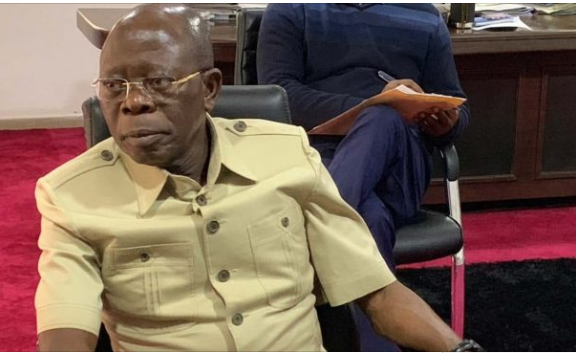
The lawmaker representing Edo North Senatorial District, Adams Oshiomhole, has thrown his weight behind the creation of state police in Nigeria.

Oshiomole expressed his support on Thursday at Arise Television’s Town Hall on State Police.

According to him, governors cannot be held accountable as chief security officers without having operational control over policing.

He described Nigeria’s current policing structure as contradictory, stressing that governors fund security operations but lack the authority to recruit, deploy or discipline officers.

The former Edo State governor also dismissed fears that state police would be abused, insisting that misuse of power already exists under the current centralised system and should be addressed through democratic
accountability and public oversight.

“Various state governors can’t be the Chief Security Officers of their respective states without operational control over policing.

“Decentralised policing would improve security, clarify responsibility and align Nigeria’s federal system with its constitutional structure.

“Lawmakers should move from debate to its implementation,” he said.

Recall that both chambers of the National Assembly passed a bill for the creation of state police in Nigeria.

Aprokorepublic

READ ALSO:  FG Inaugurates NITDA Regional Office In Enugu

Ojogwu Godwin Chukwudi hailed from Delta State. A young talented personality, Alumnus of Delta State university,Abraka Studied Library and information science. He is an intellectual cyber communicator expert and a prolific blogger professional.

NEWS

Senator Uche Ekwunife Secures ANSAA Out-of-Home Campaign Permit Ahead of 2027 Election (See Pictures)

Published

on

Yesterday, APC Senatorial Candidate for Anambra Central, Senator Uche Ekwunife, CON, officially obtained the Anambra State Signage and Advertisement Agency (ANSAA) Out-of-Home Political Campaign Permit ahead of the 2027 General Elections.

The permit, issued in preparation for the election scheduled for January 16, 2027, was presented on behalf of ANSAA by the Assistant General Manager and Officer-in-Charge, Engr. Ngobili Chika (ARPA), to Senator Uche Ekwunife, CON.

The approval authorizes the APC Senatorial Candidate to commence the lawful deployment of approved out-of-home political campaign materials across the Anambra Central Senatorial District, in line with the agency’s regulations and guidelines.

The permitted campaign materials include posters, banners, branded vehicles, public address systems, flyers, campaign T-shirts, street storm materials, rally branding, and other approved political publicity materials.

The development underscores the importance of conducting political campaigns within the framework of existing laws and regulatory requirements as political activities intensify ahead of the 2027 elections.

ANSAA, as the state agency responsible for regulating signage and outdoor advertising.

With the permit secured, Senator Uche Ekwunife’s campaign team can now proceed with the deployment of approved outdoor campaign materials across Anambra Central in accordance with ANSAA regulations.

See picture below

READ ALSO:  Presidency Fires Back At Atiku Over Borno Airstrike Criticism
Continue Reading

NEWS

Ogun Horror: How Women Were Kept To Produce Babies For Sale

Published

on

Operatives of the Ogun State Police Command have dismantled an alleged baby factory in the Mowe area of the state, rescuing two pregnant women and four children.

The command also said it arrested six suspects in connection with the incident.

The command’s Public Relations Officer, DSP Oluseyi Babaseyi, disclosed this in a statement on Tuesday.

Babaseyi said the operation was carried out at about 8am on Monday, August 24, 2026, at Toluwalase Street, Abaren Village, via Gbarinmole, Mowe, following sustained intelligence on alleged human trafficking and illegal adoption activities at the facility.

He stated that the two rescued pregnant women were Ilesanmi Foluke, 23, who was seven months pregnant, and Ejekwa Melody, 20, who was eight months pregnant.

He added that four children, comprising two boys and two girls, were also rescued during the operation.

According to Babaseyi, the suspects arrested were Florence Glory Ogbona, 58; Magdalene Julius, 63; Chidike Egwuonwu, 40; Onyechu Chidike, 35; Stephen Ogbona, 39; and an attending nurse, Oseni Kusamotu Idaya.

The PPRO noted that further intelligence-led operations took police operatives to a hospital within the Mowe axis, where another alleged victim, Blessing Bright Effiong, 26, had reportedly given birth to a baby boy on August 20.

Babaseyi said the woman was found receiving medical treatment at the hospital, but the whereabouts of her newborn could not be established.

“The whereabouts of the newborn child could not be accounted for, prompting the arrest of the attending nurse in locating the infant,” the statement said.

READ ALSO:  US Publishes Photos, Names of 124 Nigerians Set for Deportation

The command said the case was being transferred to the State Criminal Investigation Department, Eleweran, Abeokuta, for further investigation.

The spokesperson said investigators would work to establish the full extent of the alleged syndicate’s activities, locate the missing newborn and ensure the prosecution of any suspect found culpable.

The building. CREDIT: Ogun Police Command

Reacting, the Commissioner of Police in the state, Bode Ojajuni, commended the officers involved in the operation and reaffirmed the command’s commitment to tackling human trafficking, child trading and other forms of violent crime.

“The CP further urges residents to remain vigilant and continue to support the Police by providing timely and credible information, assuring them that the Command will sustain intelligence-led policing to ensure the safety and protection of all citizens,” Babaseyi added.

PUNCH Online reported on April 17 that operatives of the Nigeria Security and Civil Defence Corps, Lagos State Command, had busted a baby factory in Okuju, Ilado, Badagry area of Lagos State.

In the operation, operatives rescued 18 pregnant women and 10 children and arrested the operators of the facility, Joy Okeke and Raphael Agwu.

The victims were said to have subscribed to the facility through an offer on a Facebook platform.

Continue Reading

NEWS

2027 Battle Lines Drawn: Dino Tells Tinubu To Get Ready To Go

Published

on


A chieftain of the African Democratic Congress, Dino Melaye, has urged President Bola Tinubu and members of his family to start packing their belongings from the Presidential Villa.

He declared that the ADC will defeat the ruling All Progressives Congress in the 2027 general elections.

Melaye said the outcome of the election would reflect Nigerians’ growing dissatisfaction with the Tinubu administration, which he accused of failing to address hunger, insecurity and other challenges confronting the country.

The former senator and lawyer spoke in an interview with Arise TV on Monday.

He expressed confidence in the ADC’s chances, saying the party’s winning strategy was straightforward because Nigerians were ready for a change of government.

“The winning strategy for the ADC is very simple. The people are with us. The people are tired of maladministration.

“They are tired of lies. They are tired of borrowing. They are tired of three budgets in three successions not being implemented,” Melaye said.

He alleged that despite the government borrowing money to fund its budgets, several contracts awarded by the government remained unpaid.

“For example, you say you borrowed money to run the budget. You have borrowed the money. You have collected the money. But the budget has not been run.

“The budget has not been funded. Contracts awarded in 2024 have not been paid for. You are still implementing the 2024 budget in 2026,” he said.

Melaye said the hardship, insecurity, killings and alleged corruption in the country had created a disconnect between Nigerians and the government.

READ ALSO:  NDLEA Seizes 498kg of Cannabis Hidden in Edo Shrine

He maintained that Nigerians were watching the developments in the country and would express their dissatisfaction through the ballot.

“So I am telling you that this enchantment, the hunger in the land, the insecurity in the land, the killings in the land, the stealing, overstealing that is going on in the land already have shown and demonstrated that there is a complete disconnect between the people and government,” he said.

The ADC chieftain also criticised the Tinubu administration, saying Nigerians were now afraid of government rather than the government being mindful of the reactions of the people.

“But under Tinubu administration, people are afraid of government because they are so brazen, they are so wicked, they are so nonchalant, they don’t give a damn,” he said.

Melaye further accused the President of making comments suggesting that election rigging, violence and ballot snatching were acceptable in politics.

He said such statements were inappropriate for a President who should serve as a role model to young Nigerians.

“You have a president that have come out on air to tell the whole world that all is fair in politics. Rigging is fair in politics. Violence is fair in politics. Ballot snatching is fair in politics,” he said.

Melaye predicted that the result of the 2027 election would lead to a change of government, urging the President and his family to prepare to leave the Villa.

“And I’m telling you that the results will tell in January. The president and his family members should begin to pack their luggage and things from the villa, including those in the boys’ quarters of the villa, because there will be a change of government,” he said.

READ ALSO:  ADC moves to reconcile Bauchi factions after court verdict

Melaye resigned from the Peoples Democratic Party in July 2025 and joined the ADC, after previously serving as spokesperson for the party’s 2023 presidential candidate, Atiku Abubakar.

He has since become one of the ADC’s most vocal figures, pursuing legal challenges on the party’s behalf and clashing publicly with the Independent National Electoral Commission

Continue Reading

NEWS

Obi vs Atiku: The Big Fight Over Fuel Subsidy Removal

Published

on


The Presidential candidate of the Nigerian Democratic Congress, NDC, Mr. Peter Obi, has disagreed with the presidential candidate of the African Democratic Congress, ADC, Alhaji Atiku Abubakar, over his proposed return of fuel subsidy if elected in 2027.

Meanwhile, the presidential candidates of other opposition political parties, yesterday, clashed over Nigeria’s worsening security situation, policing structure, fuel subsidy and the economy as the race for the 2027 presidency took centre stage at the NBA, conference in Port Harcourt.

Obi, who accused the Federal Government of mismanaging the savings from the proceeds of fuel susidy removal, said it was not enough reason to bring it back.

The ex-governor of Anambra State spoke, yesterday, at the Nigerian Bar Association, NBA, conference in Port Harcourt, Rivers State, while reacting to the debate over whether fuel subsidy should be restored as proposed by Atiku.

Atiku, who campaigned for the removal of fuel subsidy during the 2023, presidential election, had said he would restore the policy if elected president in 2027.

But Obi maintained that subsidy removal remained necessary, arguing that the problem was the failure to properly manage and invest the resources saved from the policy.

“I subscribe and I maintain that we need to remove subsidy. Mismanagement of the proceeds should not be the reason for not removing it.

“What we should have done is that when we removed it, we should have given the people alternative usage for the subsidy.

“What we have today is that that removal and the attendant resources being recovered is also being mismanaged and stolen,” he said.

READ ALSO:  NDLEA Seizes 498kg of Cannabis Hidden in Edo Shrine

The former governor said he had anticipated the need for a structured approach to subsidy removal and had outlined his position in his manifesto ahead of the 2023 election.

“Go to my manifesto, I said it before, I said I will do it in an organised manner and whatever we recover would be invested appropriately,” Obi said.

President Bola Tinubu announced the removal of the petrol subsidy on his inauguration day in May 2023, triggering a sharp increase in petrol prices and widespread concerns over the rising cost of living.

Amaechi, Sowore, other presidential candidates fault FG’s policies

The candidates, who spoke during a high-powered panel session, offered sharply different solutions to the country’s challenges, with some calling for a change of government, while others advocated deeper reforms of the existing system.

The debate came as the Chief of Staff to President Tinubu, Mr. Femi Gbajabiamila, defended the federal government’s proposed state police reform, saying the administration had confronted an issue that successive governments had avoided.

Former Rivers State governor and vice presidential candidate of African Democratic Congress, ADC, Mr. Rotimi Amaechi, said the economy could only be stabilised through massive job creation, local production and policies that would put more money in the pockets of Nigerians.

Amaechi, who recalled his record as governor of Rivers State, said his administration built more than 500 primary schools, over 300 health centres and more than 200 roads, while using intelligence gathering to drastically reduce crime.

He also promised that an Atiku Abubakar-Amaechi administration would ensure equitable distribution of political appointments across the country, criticising what he described as concentration of appointments under the Tinubu administration.

READ ALSO:  Police Boss Speaks Tough As Anambra Heads To The Polls

The presidential candidate of the African Action Congress, AAC, Omoyele Sowore, meanwhile, called for a change of government, arguing that Nigeria’s security crisis could not be resolved under the present leadership.

Sowore also took aim at the federal government’s fuel subsidy policy, insisting that he had consistently opposed subsidy because of the way it was administered.

He said: “If there is anybody that has been consistent in the removal of fuel subsidy, it has been me. The question about fuel subsidy is: who are you subsidising? You are subsidising the elite. You are subsidising the governors.”

On security, he and the Social Democratic Party, SDP, presidential candidate, Adewale Adebayo, argued that Nigeria required a change in leadership to tackle terrorism and other security threats.

Adebayo, however, differed with most of the candidates on the structure of policing, advocating a three-tier system involving federal, state and local government police.

Former Cross River State governor, Donald Duke, said leadership remained the central issue confronting Nigeria, arguing that getting the leadership question right would have a multiplier effect on other sectors.

“If we get the leadership right, everything else will fall into place,” Duke said, while condemning the influence of ethnicity in Nigerian politics and advocating reforms to strengthen the country’s presidential system.

Earlier, Gbajabiamila, in a keynote address, titled “Policing in Transition,” said the Tinubu administration’s decision to pursue state police was aimed at addressing the limitations of the existing centralised policing system.

“Centralised policing without safeguards will bring about more chaos,” he warned, explaining that the proposed reform was designed around a dual policing system that would address existing gaps.

READ ALSO:  We'll Not Tolerate Assault, Killing of Police Officers Anymore -IGP

Addressing fears that state police could be abused by governors against political opponents, Gbajabiamila queried: “Who polices the police?”

He identified inadequate police manpower and deployment as major challenges, noting that Nigeria had about one policeman to every 650 people, compared with an international benchmark of one to every 450.

He added that the situation was worsened by the deployment of many police officers to administrative and escort duties, rather than core policing responsibilities.

The presidential aide also stressed training, professionalism and institutional safeguards, saying policing must become a respected career capable of attracting competent Nigerians.

He acknowledged that governors, as elected chief executives, must have executive authority but insisted that they should not be allowed to order the arrest of political opponents.

He also said police officers who rejected unlawful orders must be protected, arguing that such safeguards must be backed by strong institutions, rather than mere assurances.

The NBA conference thus provided one of the earliest major platforms for 2027 presidential hopefuls to publicly test their competing positions on security, economic management and governance, setting the stage for a potentially intense political contest ahead of the general elections.


Continue Reading

NEWS

Travellers Cry Out: Umahi To Inspect Benin-Asaba Road Over Endless Traffic

Published

on

The Minister of Works, David Umahi, has said he will visit the Benin-Asaba road on Tuesday following widespread complaints, protests and severe gridlock caused by the deteriorating condition of the federal highway.

Umahi disclosed this during the flag-off ceremony for the dualisation of the Ibadan-Ijebu-Ode Road, according to a video shared on Monday by his Senior Special Assistant on Media, Francis Nwaze.

The minister said he would meet with independent engineers, the concessionaire handling the project and the state government to find a solution to the worsening situation.

“Tomorrow, we are off to Benin-Asaba. I want Nigerians to be assured that when we get there, we’ll solve that problem,” Umahi said.

He explained that the poor state of the road was linked to the Federal Government’s attempt to involve the private sector in road development through concession arrangements.

“It’s not caused by Ministry of Works; it’s caused by, you know, our attempt to involve private sector in road development, as it’s done in other places,” he said.

Umahi alleged that the concessionaire had removed more than 30 kilometres of asphalt from the road without completing the expected rehabilitation.

“But this concessionaire came and removed over 30 km of the asphalt and threw it away and threw it in the yard and left. And today, people are suffering,” he said.

The minister said he would engage the independent engineers, the concessionaire and the ministry’s lawyers, while also holding discussions with the Edo State Government.

“So, there’s going to be a robust engagement, even with the governor of Edo State,” he added.

READ ALSO:  ADC moves to reconcile Bauchi factions after court verdict

The planned visit comes amid mounting complaints over the Benin-Agbor section of the highway, where residents, motorists and transport workers have staged protests over prolonged gridlock and the poor condition of the road.

The deteriorating road has reportedly left motorists and travellers stranded for days, with videos circulating online showing motorists stuck in traffic and some travellers spending nights in their vehicles.

Umahi also disclosed that his Minister of State would visit the Ifaki-Ado-Ekiti road, where a section of the federal highway has also reportedly collapsed, causing severe traffic congestion and leaving articulated vehicles stranded.

He said President Bola Tinubu had directed the ministry in 2024 to take over the project after inspecting its condition, adding that the road had since been redesigned.

“We have redesigned it, and when he goes, he’s going to bring up a report, which we will submit to Mr. President,” Umahi said.

Continue Reading

NEWS

Is Fuel Price About To Go Up? Dangote Supply Falls, Imports Rise

Published

on


The supply of petrol from the Dangote Petroleum Refinery fell by 21 per cent in July 2026, while imports increased by 9 per cent, fresh data from the Nigerian Midstream and Downstream Petroleum Regulatory Authority (NMDPRA) showed yesterday.

The development came despite an improvement in petrol stock sufficiency during the month, with available reserves rising to 22.4 days from 19.7 days in June, even as the country remained below the regulatory minimum fuel sufficiency threshold of 30 days.

According to the NMDPRA’s July 2026 Midstream and Downstream Statistics, average daily petrol receipts fell from 50.6 million litres in June to 45.5 million litres in July, representing a 10 per cent month-on-month decline.

The contraction was driven principally by domestic supply undertaken by the Dangote Refinery, which dropped from 32.5 million litres per day to 25.8 million litres per day, a 21 per cent reduction. At the same time, imports rose from 18.1 million litres per day to 19.7 million litres per day, representing a 9 per cent increase.

The figures underlined a renewed increase in Nigeria’s reliance on imported petrol, following months in which domestic refining had increasingly displaced import as the debate over whether to end fuel importation altogether or create some form of competition for the Dangote facility rages.

However, the July figures also showed the significance of the Dangote refinery to the domestic market. The refinery recorded average capacity utilisation of 71.09 per cent during the month. It produced 25.9 million litres of petrol per day and supplied 25.8 million litres daily to the domestic market.

READ ALSO:  Nigeria Won’t Fix Petrol Prices Despite Middle East War — Finance Minister

The refinery also produced 19.1 million litres per day of Automotive Gas Oil (AGO) or diesel and 15.6 million litres per day of Aviation Turbine Kerosene (ATK). Its domestic receipts stood at 15.7 million litres per day for AGO and 1.9 million litres per day for ATK.

But during the same period, exports amounted to 11 million litres per day of AGO and 11.6 million litres per day of ATK or kerosene. Its closing stock at the end of July stood at 446.1 million litres for PMS, 162.3 million litres for AGO and 217.4 million litres for ATK.

The month-on-month shift in petrol supply was particularly notable against the longer-term trend. In July 2025, domestic refineries supplied an average 16.5 million litres of PMS daily, while imports accounted for 36.1 million litres. By July 2026, domestic supply had risen 56 per cent year-on-year to 25.8 million litres per day, while imports had fallen 45 per cent to 19.7 million litres per day.

Thus, although imports increased between June and July 2026, they remained substantially below their level a year earlier. The July 2026 total PMS supply of 45.5 million litres per day was also 13 per cent below the 52.6 million litres recorded in July 2025.

In the same vein, the weaker petrol supply coincided with an even sharper fall in recorded consumption. PMS consumption dropped from 47.4 million litres per day in June to 35.7 million litres per day in July, representing a 25 per cent decline. NMDPRA said consumption data are based on volumes trucked out into the domestic market.

READ ALSO:  Police inspector shot dead by gunmen in Makurdi

Despite the lower supply, the improvement in stock sufficiency suggestee that the decline in domestic withdrawals helped ease pressure on available petrol inventories. PMS stock sufficiency increased by about 14 per cent from 19.7 days in June to 22.4 days in July.

However, the figure remained below the 30-day minimum threshold, indicating that the improvement in inventories did not yet translate into a fully comfortable national supply position. The data also revealed significant movements in other petroleum products.

AGO supply jumped 46 per cent month-on-month from 16.2 million litres per day in June to 23.6 million litres per day in July. Domestic AGO supply, however, declined 3 per cent from 16.2 million litres to 15.7 million litres per day, meaning the increase in overall supply was driven by the resumption of imports, which reached 7.9 million litres per day in July from zero in June.

AGO consumption fell 8 per cent from 16 million litres to 14.7 million litres per day, while diesel stock sufficiency rose 25 per cent from 37.1 days to 46.5 days.

Also, LPG supply increased 4 per cent from 5.1 kilotonnes per day to 5.3 kilotonnes per day. Domestic LPG supply rose 22 per cent from 3.6 kilotonnes to 4.4 kilotonnes per day, more than offsetting a 40 per cent decline in imports from 1.5 kilotonnes to 0.9 kilotonnes per day.

In contrast, aviation fuel supply weakened during the period under consideration. ATK receipts declined 24 per cent from 2.5 million litres per day to 1.9 million litres per day, while consumption fell 41 per cent from 2.9 million litres to 1.7 million litres per day.

READ ALSO:  It’s Shocking Tinubu Sacked Fubara And Left Wike - Rivers State Government

Crude oil receipts by domestic refineries also fell 8 per cent, from 0.632 million barrels per day in June to 0.585 million barrels per day in July. Besides, domestic gas supply declined 8 per cent from 5.116 billion standard cubic feet per day to 4.723 billion cubic feet per day.

Continue Reading

NEWS

How Immigration Plans To Use Tech To Lock Down Nigeria’s Borders

Published

on

The Nigeria Immigration Service says the service is accelerating the use of digital identity systems, automated border controls and intelligence-led surveillance as part of efforts to tighten Nigeria’s borders without undermining legitimate movement and cross-border trade.

The Comptroller-General of the NIS, Kemi Nandap, disclosed this on Monday in Lagos at the 2026 conference of the African Borderlands Research Network.

The conference, themed “The Connected Borderlands: Socio-Cultural Integration and the Centrality of Policy, Research, and Security,” brought together researchers, policymakers, security practitioners and development partners to examine the changing security and socio-economic dynamics of Africa’s border regions.

Nandap said Nigeria’s approach to border management was being reshaped by changing migration patterns, regional integration, expanding cross-border commerce and increasingly sophisticated security threats.

She argued that borders could no longer be treated simply as lines separating countries, given the extent to which communities, families, cultures and economies operate across them.

According to her, the challenge for governments was to secure borders while ensuring that legitimate travellers, traders and communities were not unnecessarily restricted.

“Borders should no longer be viewed merely as geographical lines separating sovereign states, but as dynamic spaces where families, communities and cultures interact and where legitimate trade and movement take place,” she said.

Nandap identified human trafficking, migrant smuggling, identity fraud, organised crime, terrorism and cyber-enabled offences among the threats increasingly exploiting cross-border networks.

“Addressing them requires us to work differently and, importantly, to work together,” she said.

She said the NIS was consequently combining the professional expertise of its personnel with digital technology, intelligence gathering and inter-agency cooperation to detect and respond to threats more effectively.

READ ALSO:  NDLEA Seizes 498kg of Cannabis Hidden in Edo Shrine

Nigeria, she noted, had been moving towards technology-driven border administration for nearly two decades, becoming the first African country to introduce the electronic passport in 2007.

The NIS boss said the country had since upgraded its e-Passport system with enhanced biometric and security features, while digitising several stages of passport processing, including applications, payments and identity verification.

She said the centralisation of passport personalisation had also strengthened the integrity of the production process, while Nigeria’s participation in the International Civil Aviation Organisation’s Public Key Directory had enhanced the international verification of its electronic passports.

Nandap added that contactless biometric passport services were being deployed to make passport services more accessible to Nigerians outside the country without compromising security requirements.

At the country’s international airports, she said, automated border control systems, including electronic gates, were also being deployed to speed up passenger processing through biometric verification.

The service is also investing in surveillance equipment, command and control systems, communications infrastructure and integrated data platforms covering Nigeria’s land, air and maritime borders, she said.

Nandap, however, cautioned against treating technology as an end in itself.

“Their fundamental purpose is to enhance the capacity of our officers to make timely and well-informed decisions, identify emerging risks at an earlier stage and improve operational coordination, and facilitate the seamless movement of legitimate travellers while safeguarding national security,” she said.

She maintained that technology would not eliminate the need for competent immigration personnel, stressing the importance of professional judgement, experience and integrity in border operations.

READ ALSO:  PBAT Door-To-Door Movement Gets Big Boost as Akpabio, Abbas, Others Inaugurate Exco

Beyond technology and institutional cooperation, Nandap called for stronger partnerships with communities living along Nigeria’s borders, describing them as an important source of local intelligence and strategic partners in border management.

The Chairman of ABORNE, Prof Paul Nugent, said borderlands had repeatedly become focal points of government security interventions during health emergencies and periods of regional instability.

He cited the Ebola outbreak, COVID-19 pandemic and regional insurgencies as examples of crises that had resulted in border restrictions and, in some cases, prolonged closures.

Nugent said ABORNE was seeking to narrow the gap between academic research and policymaking by bringing researchers into closer engagement with border agencies, policymakers and practitioners working in border communities.

He also urged a shift away from portraying African borderlands primarily as zones of insecurity and disorder, arguing that many had developed into centres of commerce, urban innovation and cultural exchange.

Prof Anthony Asiwaju, a former Director of the Centre for African Regional Integration and Border Studies, also commended the conference for promoting research and policy discussions around the future of African borderlands.

Continue Reading

NEWS

What NAFDAC’s New Sachet Alcohol Crackdown Means For You

Published

on


National Agency for Food and Drug Administration and Control (NAFDAC) has intensified enforcement of the federal government’s ban on alcoholic beverages packaged in sachets and PET/plastic bottles below 200ml, warning manufacturers, distributors, and retailers to comply or face severe sanctions.

NAFDAC said the enforcement was aimed at completely removing prohibited alcoholic products from the Nigerian market and reducing easy access to highly concentrated alcoholic drinks, particularly among children and young people.

The latest action followed an Irrevocable Enforcement Undertaking signed by Distillers and Blenders Association of Nigeria (DIBAN), Association of Food, Beverage and Tobacco Employers (AFBTE), and their member companies.

Under the undertaking, affected manufacturers were required to immediately recall all alcoholic beverages packaged in sachets and PET bottles below 200ml from distributors, warehouses, and other points within the supply chain.

NAFDAC said recalled products will be verified and destroyed under its supervision, with manufacturers bearing the full cost of the destruction.

The agency also said factories involved in producing the prohibited pack sizes will not be allowed to reopen until there was satisfactory evidence that the relevant production lines had been dismantled, permanently disabled, or reconfigured to prevent further production.

The ban, however, did not emerge suddenly.

According to NAFDAC, concerns over the widespread availability of high-alcohol-content drinks in sachets and small bottles dates back to 2018, when regulators raised concerns about their affordability, portability, and accessibility to minors.

Following consultations involving NAFDAC, Federal Ministry of Health, Federal Competition and Consumer Protection Commission (FCCPC), DIBAN, and AFBTE, a five-year moratorium was agreed upon in December 2018.

READ ALSO:  Ohanaeze Election: Ex-IGP Okiro Withdraws From Race

The moratorium gave manufacturers until January 31, 2024 to reconfigure production lines, transition to larger packaging, and phase out sachet alcohol and small-volume containers.

When the deadline expired, NAFDAC commenced enforcement in February 2024.

However, resistance from industry stakeholders and intervention by the National Assembly led to further consultations and an extension of the deadline to December 31, 2025.

The full ban subsequently took effect on January 1, 2026, covering alcoholic beverages packaged in sachets, PET bottles below 200ml, and glass bottles below 200ml.

NAFDAC said the policy was supported by research highlighting the accessibility of such products to minors.

The agency cited findings indicating that 47.2 per cent of minors and 48.8 per cent of underage persons who procured alcoholic drinks obtained them in sachets, while 41.2 per cent of minors and 47.2 per cent of underage persons procured them in PET bottles.

In January 2026, NAFDAC commenced its first-tier enforcement, focusing on manufacturers. The agency said prohibited products found within manufacturing facilities were evacuated and destroyed.

By July, the agency escalated the exercise to nationwide mop-up operations across markets, motor parks, retail outlets, bars, and distribution centres.

The crackdown resulted in the closure of some factories and the arrest of staff of companies found producing prohibited sachet alcoholic beverages.

NAFDAC said companies that violated its directives will also be required to pay applicable investigative charges and regulatory fees.

It warned that facilities would only be reopened after satisfying a number of conditions, including completing the nationwide recall, paying applicable charges, destroying recalled products under NAFDAC supervision, and passing inspection and certification by the agency.

READ ALSO:  Senate vs Trump: Lawmakers Back Resolution to End Iran War

Companies that fail to comply could face continued closure, placement on NAFDAC’s Regulatory Watchlist, suspension or revocation of product registrations, and criminal prosecution where applicable.

Director-General of NAFDAC, Professor Mojisola Adeyeye, FAS, said the agency remained committed to protecting public health while working with industry stakeholders to ensure compliance.

NAFDAC stressed that its position was not against alcohol consumption itself but against the proliferation of high-alcohol products in small, inexpensive containers that made them easier for children and young people to access.

The agency urged members of the public to report the manufacture, distribution, or sale of alcoholic beverages packaged in sachets and PET bottles below 200ml through NAFDAC’s official communication channels or at the nearest NAFDAC office.

Continue Reading

NEWS

After Record Profits, MTN Drops $375M Bombshell

Published

on


South African mobile operator MTN Group said yesterday its board had approved a 6 billion rand ($375 million) share buyback programme as it reported a 21.3 per cent rise in half-year adjusted profit and strong cash generation.

A Reuters report quoted MTN’s Chief Executive Officer, Ralph Mupita, as telling  journalists that the buyback programme would begin on Monday. At 1005 GMT, MTN shares were up 4.61 per cent at 201 rand, the report stated.

Africa’s biggest telecom operator, with more than 317 million customers across 19 markets, said adjusted Headline Earnings Per Share (HEPS) rose to 793 cents in the six months ended June 30 from 654 cents a year earlier.

Reported HEPS, however, fell 5.8 per cent, hit by a 3.9 billion rand non-cash impairment on its 49 per cent stake in Irancell, reflecting Iran’s hyperinflation and the sharp depreciation of the rial. Foreign exchange losses in South Sudan also weighed on earnings, the Reuters report added.

The impairment comes as MTN seeks to exit Iran, its last remaining operation in a broader withdrawal from the Middle East. The process has been complicated by U.S. sanctions, in place since May 2018, which have also prevented the company from repatriating about 880 million rand in trapped dividends, Mupita said.

“With the sanctions in place, we can’t put any money in and we can’t take any money out. But if the situation did change in a way where there was a removal of sanctions we would continue with executing our Middle East exit strategy,” he added.

READ ALSO:  We'll Not Tolerate Assault, Killing of Police Officers Anymore -IGP

According to the report, outside Iran, MTN’s biggest market Nigeria, along with Ghana and Uganda, helped lift service revenue 17.5 per cent to 115.3 billion rand. Growth in South Africa was 1.5 per cent.

MTN said strong subscriber additions and growth in digital and fintech services also supported performance.

Core earnings rose 24.4 per cent to 56 billion rand, while the EBITDA margin widened 3.1 percentage points to 47.1 per cent .

Besides, the telecom firm said the remaining hurdles to its tower deal with IHS Towers are largely regulatory, having received conditional approval from Nigeria’s competition regulator, which requires it to reduce its stake in the Nigerian business by up to 30 per cent over time at market prices.

Continue Reading

Trending